The DOJ's Deals with the Devils
Has anyone heard of the United States Department of Justice haggling with an adversary in court over cryptocurrency? That, to say the least, is weird.
The Background — The Istanbul Connection — The US Remissions Framework — It’s Hammer Time in the US — They’re Not Friends (Everybody Lies) — The Devil is in the Details — The LIFO Forfeiture Machine — The Legal Side of the Crypto Scams Recovery Industry — No Deal
The Background
The DOJ has been trying to quietly settle with a self-described online gaming and wagering company, Infiniweb, for the $225M in USDT the US government has *frozen* in 2023 and filed for forfeiture in 2025. (To forfeit an asset is to legally entitle all ownership rights on it to the US government permanently.) Infiniweb claims the 225M USDT and contests its forfeiture. Month after month since early 2026, the DOJ kept on asking for an extension while it is trying to negotiate with Infiniweb on how to avoid trial on the merits of its claim and split the pot instead —likely since DOJ knows it cannot win forfeiture in open court. Detailed why, in my first post on this story:
Court records show that Infiniweb must be driving a hard bargain. Indeed, when has this ever been seen for the DOJ?
One fact about Infiniweb: it is a cancelled, shut down, and banned Philippine Offshore Gaming Operator a.k.a. “POGO”, which are widely known in the Philippines as hotbeds of online scammers and human trafficking during in their heydey circa 2020-2024. [Video: The Deep Web of POGOs]. Infiniweb, in fact, is accused by the US DOJ itself to be a shadowy shell company for Chinese human trafficking and cryptocurrency fraud factories.
Simultaneously, the DOJ has also been trying to strike out all scam victims claiming parts of the $225M, as well as other seized assets linked to pig butchering scams, as reported by the ICIJ: Questions swirl around US plans for record $15B Prince Group crypto seizure. The DOJ plan was to disqualify all scam victims’ claims and funnel them to a questionable and arbitrary “remissions” process. Assuming there are leftovers from a settlement with Infiniweb, the rest will go to the US Treasury’s Asset Forfeiture Fund — a slush fund created primarily for confiscated drug money. (More on this later.)
So we can be clear what’s going on here: the DOJ is negotiating away fraud victims’ money to criminals to save its own skin (detailed in my first post on this).
The court seemed to tire of the repeated extension requests for settlement talks outside of court, and had set July 23, 2026 for a hearing to make a ruling. Claimants rushed out with their motions in a do or die moment. It seemed imminent that the DOJ will be disbursing the bulk of the $225M to the Infiniweb criminals.
Nivie (introduced in my first post) came out with all guns blazing. She filed Document 79 on https://www.courtlistener.com/docket/70571294/united-states-v-approximately-225364961-usdt/. Don’t miss the exhibits.
I will summarize and discuss on the important points, the head-spinning timeline on how the US really got to get ahold of $225M in USDT. It involves senators, institutional arm-twisting, state-to-state unrelations, undue process, victims as unpaid skilled labor, whistleblowers-to-be, and the $225M’s sprawling links to other massive cryptocurrency forfeitures by the US, including the Prince Group’s ~$15B in BTC. There’s much to unpack, and its 45 pages of her filing was brimming.
Document 79: Memorandum in Support
The Istanbul Connection
Nivie is asking the court, first, for a Preliminary Injunction to stop any planned transfers of her portion of the $225M without first resolving all claims. As well, she is asking for an immediate open trial on the merits of all their claims. Finally, she is asking for a neutral custodian of those funds while claims are being resolved.
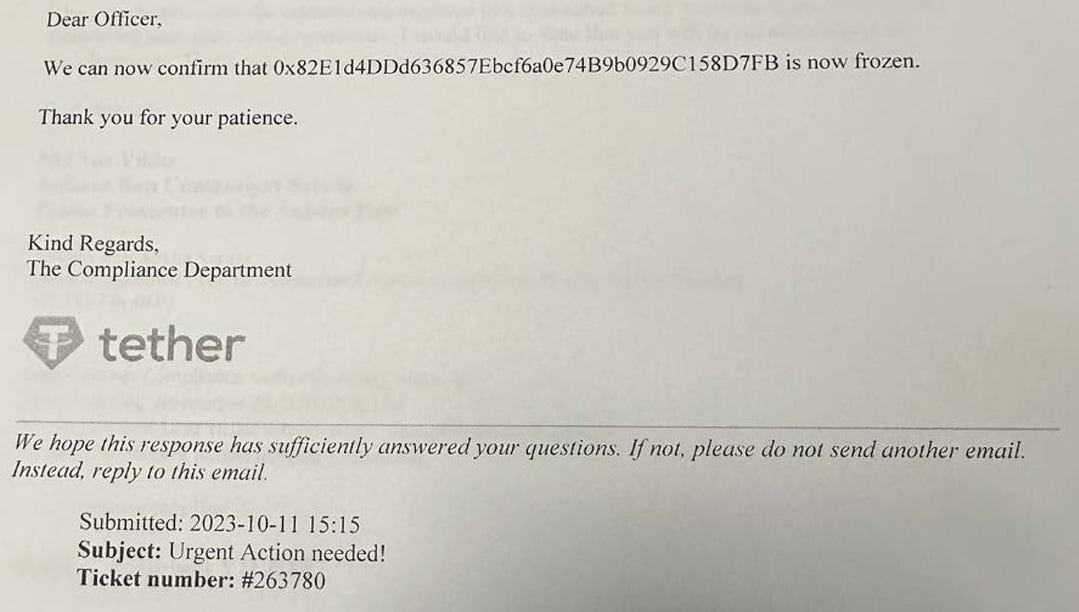
As already revealed in Nivie’s first Verified Claim, the biggest among the USDT wallets comprising the $225M, 0x82e1d4ddd636857ebcf6a0e74b9b0929c158d7fb, has already been frozen by Tether upon orders of a Turkish court, almost 4 months before its “voluntary” freeze by Tether for the US Secret Service. There was no coherent US seizure warrant for any of it until 2 years later.
See: New claim disputes facts of US landmark crypto seizure - Compliance Corylated
The Turkish court action stemmed from a case Nivie has initiated as a complainant and private prosecutor under their laws. It wasn’t a mere civil suit, but had morphed into a full-blown criminal trial of a large money-laundering ring, with hundreds arrested and real assets and physical evidences seized. In fact, the trials are still ongoing, with the Turkish state currently prosecuting it, but its courts have already held the 0x82e wallet in reserve for judgement holder Nivie.
This is in contrast to the US investigation underlying its original forfeiture claim, which was flimsy thin in evidence in comparison and trafficking in innuendos. It is likely an exclusively “desk-based investigation” — no arrests, no search warrants, no physical evidence, no surveillance, no informants, no undercover agents, no grand jury testimony, no charged defendants, nada. Now you see why the DOJ was squirming and haggling with Infiniweb over the $225M and shying away from open trial.
The US Remissions Framework
If one wonders why Nivie immediately got judgement for restitution in Turkey, it might be worth pausing to refer to Nivie’s filing which briefly explains the differences in the restitution framework between the US and other countries like Turkey.
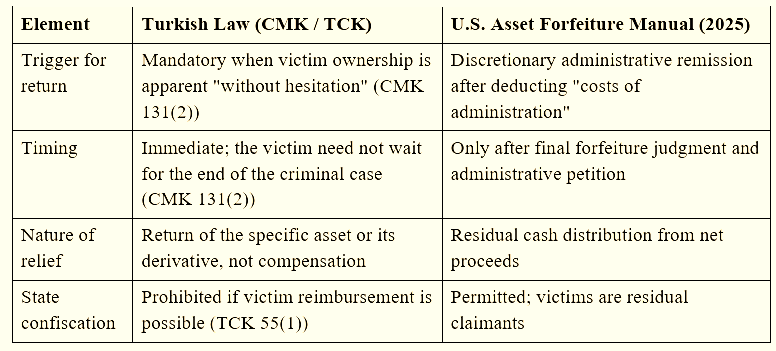
Strikingly, the US DOJ’s position is that seized assets from scams are to be forfeited to the US government, but victims can later petition for remission of their losses. In the US framework, when assets are forfeited, the court will have awarded all rights to the assets to the US government. All prior rights to the assets by any claimants, including criminals, victims and all other past owners, are immaterial and over. So, it will be up to the DOJ to decide how much any one scam victim deserves back, based on nothing but feelings, legally speaking. It also gets to decide how much to absorb, for administrative costs (the US has a lot of bills to pay). There are no hard rules, no mandated formulas, no transparent accounting for who gets how much. This is why Nivie’s Motion for a neutral custodian was filed simultaneously, to not have a conflicted party adjudicating among victim claims AND its own interests.
US remissions are merely administrative and inherently arbitrary — a black box. With passage of 5+ years, paying restitution to victims of crime get lower in priority. Why can’t the US bureaucratic machine be trusted? Trust is a fudgy and fleeting thing, and subjectivity should be taken out of the restitution process in complex scams with thousands of victims. Further below is the demonstrated record of US government missteps (charitably speaking) on this case.
To recount, Nivie was a US victim of a sophisticated, transnational organized crime. She did her own investigations to pursue her losses. She initially collaborated with US law enforcement (LE) agents, up to a point in early 2023 when they told her her assets are irrecoverable.
But her own investigations and research showed otherwise, and she persisted in recovering her stolen assets. Her findings led her to a money-laundering nexus in Turkish territory, where she hence initiated a civil, then criminal, cases against persons named Ling Sun Dylon and Kai Li Kelly. Her findings and evidence were communicated to US LE, but they took no action on account of hers or other scam victims of this money laundering syndicate. Instead, as is painfully common for US scam victims, US LE told her that her assets are all gone; all active investigations into her case have been ended because recovery is impossible. (Where US law enforcement think their jurisdiction ends with virtual assets and non-US exchanges is hard to fathom.)
Ironically however, her Turkish fraud case stemming from the same evidence set proceeded, and state prosecutors of Turkey took extreme interest in the criminal network Nivie’s case revealed. Soon the Turkish court awarded Nivie a judgement for immediate return of her assets. Her suit became the first domino to fall in the unraveling of this syndicate in Turkey. Not only money mules were arrested; Nivie was the lead prosecution witness against the founding members and managers of this syndicate, since her investigation has directly led to them. In her recent filing, she recounted being called in to Turkey at least twice (in 2023 and 2025) to testify to her existence and the methods she used that eventually snared the criminal defendants.
Nivie’s US filing doesn’t say who the rest of the defendants are. Criminal cases in Turkey and other countries are not as open as in the US, particularly when ongoing and under gag orders. The accused there are afforded such rights against a public spectacle. Court dockets in Turkey are not considered public documents, and criminal records are strictly confidential under Turkish privacy laws. For the public, cases can only be learned from Turkish media coverage of contemporary arrests and open hearings.
The criminals used USDT with OKX and Binance accounts. OKX and Binance were both legally registered in Turkey, and so Turkish state actions in 2023 for this case affecting both exchanges prompted them to do their own verifications, freezes, and belated mandatory compliance reports (Suspicious Transaction Reports). The two exchanges were generally cooperative with their host country, a far contrast to Tether. Tether was ordered by the Turkish court in August 11, 2023 to immediately freeze the 0x82e wallet, to which Tether complied only belatedly 2 months later, after some 14M USDT have left.
It’s Hammer Time in the US
Meanwhile, pressure has been building up in the US against the giant offshore crypto companies, that by late October 2023, even pro-crypto US lawmakers Senator Cynthia Lummis and Representative French Hill wrote to the DOJ urging criminal investigations into Binance and Tether. A hammer drop by the mighty DOJ seemed imminent. It is the year of serial US government lawsuits against Binance, Coinbase, Terraform Labs, Do Kwon and Sam Bankman-Fried, in the wake of the FTX, Celsius and multimillion dollar crypto meltdowns.
Tether, which was notoriously uncooperative and recalcitrant to US government authority, did a 180 degree turn. Uncharacteristic of its entire history, Tether became very pliant to US. In a letter to US Congress dated November 16, 2023, Tether responded to Lummis & Hill that it had just voluntarily frozen on its own accord numerous wallets with USDT it says are linked to scams, about $70M. Three days later, Tether made a joint announcement with OKX about freezing 225M USDT. In December 15, 2023 they sent another letter about freezing more wallets and “onboarding” US Secret Service and the FBI. In one month, Tether became an arm of the US government.
Nivie would later discover in the 2025 DOJ seizure complaint that Tether included 0x82e in the Nov 20, 2023 “voluntary” freeze. What Tether didn’t say in their public pronouncements is that 0x82e and likely others Tether has *voluntarily frozen* have already been frozen in compliance to judicial orders (from Turkey). Worse, Nivie asserts that the US authorities knew of the existing Turkish cases on those assets and knew of Nivie’s investigative findings. (In fact, the US has already attributed to her tracing the successful seizure of other scam assets in another federal case in Colorado.) Nevertheless US authorities proceeded to compel Tether to burn and re-mint the USDT, destroying evidence in the process —her. It is not an overstatement to say that she is the evidence; her testimony and evidence for the Turkish criminal case was indispensable to the preservation of those USDT. Moneys were moving out of 0x82e before then. But because of Tether’s actions under US pressure, the legal link between the $225M and the victims, assets, and predicate crime became further removed. Simply put, US authorities scrubbed Nivie out of the picture, and now the US has no evidence to prove the criminality of the $225M.
This raises many legal questions about possession and sovereign jurisdiction over virtual assets in judicial custody of a second country, controlled by proudly non-US entities incorporated in third countries. There are also questions about the priority among judicial orders, international comity, and due process. Nivie addresses each question point by point in her memo, citing established US legal jurisprudence. Her main point is, in addition to not doing a proper case build up to those assets, the US government didn’t even follow its own laws and procedures on seizing the $225M —maybe because, these are virtual assets. Remember, the US only obtained a warrant for the $225M two years later in 2025.
A subtle point made also is that Tether is acting extra-judicially on behalf of the US government (executive branch), which may expose both the US government and Tether to a host of liabilities under US laws.
Infiniweb has helpfully pointed out in its own Motion to Dismiss (the US DOJ forfeiture attempt) that the DOJ’s forfeiture filing reads like backward tracing to scam victims after the fact of the seizure (see my first post). And now the DOJ has to suffer settlement talks with Infiniweb. This is not the only time the US DOJ was called out for seemingly making up tracing assertions out of thin air. The US has had a history of “parallel construction” investigations where the US agents make up a clean, legal trail of evidence to present in court but information was actually known through illicit and sometimes illegal means — “fruits of the poisonous tree”. (See the questions around the US seizing of $15B Prince Group Chen Zhi BTC.)
They’re Not Friends (Everybody Lies)
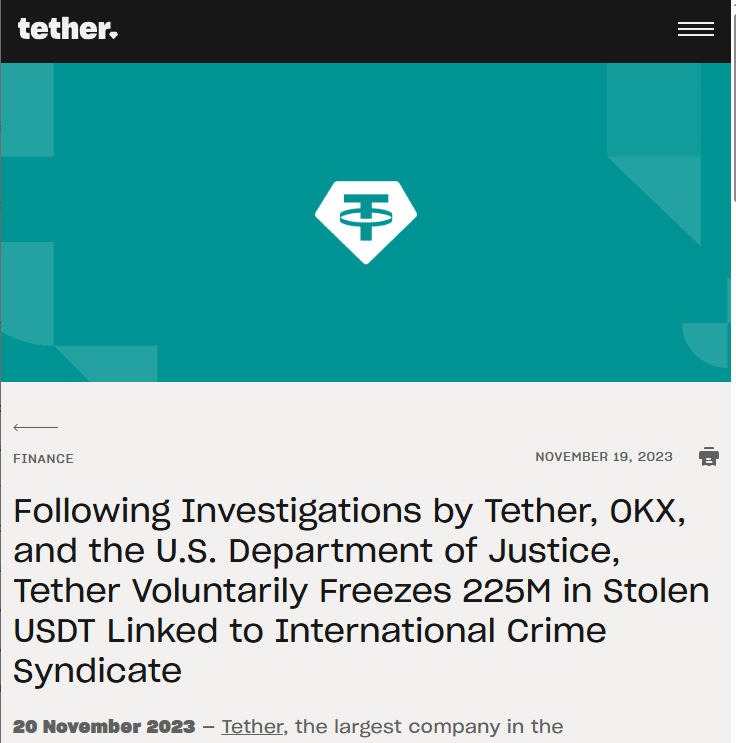
Reading the Tether, OKX and DOJ press releases about the $225M USDT freeze in November 20, 2023 would have you believing that crypto investigations and seizures involving hundreds of wallet hops, 3 blockchains, 93 deposit addresses, 140+ OKX accounts, tracing through the layering, can be done in 3 days (starting Nov 16). Their narrative is, OKX and Tether proactively identified 140+ of its accounts used for laundering USDT. OKX and Tether randomly shared data with each other and then approached the US DOJ… to say that all these $225M must be from US scam victims, please come take it?
The US DOJ admits in its original forfeiture complaint (Statements 45 & 50) and in contemporary interviews that the US just started its investigations to those wallets after OKX and Tether contacted US authorities about it. The US was informed of the wallets first, have not identified them beforehand, and had to trace backwards to victims to create an investigation to justify titling the $225M to the US government.
TRM Labs, Coinbase and Chainalysis followed suit in claiming credit. To describe the herculean task that has to be involved, circa 2023, let us quote TRM Labs:
Victim funds were initially deposited into 93 known scam deposit addresses. From there, the funds were routed through multiple layers of intermediary wallets and laundering structures. These included repeated use of peel chains, structured hops, and cross-chain swaps designed to complicate tracing. The funds moved across Ethereum, Bitcoin, and TRON networks before consolidation into USDT.
Note that most of these victims are from 2022. Coinbase itself could only attribute a paltry $2.3 million of the loot to 130 of its US customers, and retroactively: “Between February 26–29, 2024, Coinbase and several other exchanges joined a joint investigative sprint with the USSS to identify scam victims, analyze onchain flows, and help build the case for seizure.”
In spite of, and especially because, there are no US warrants (only granted in 2025), both Tether and OKX normally would have to verify on their own each wallet to be frozen. Without scam victim reports, how did Tether and OKX get the information about the $225M wallets? If the investigation went backwards, where did Tether get the confidence to start by freezing those wallets in the first place?
Answer: They already knew. They had external confirmation on those wallets, and they were already frozen anyway.
What inspired them to “voluntarily” freeze them for the unprepared US LE, unprompted?
Answer: They were forced to.
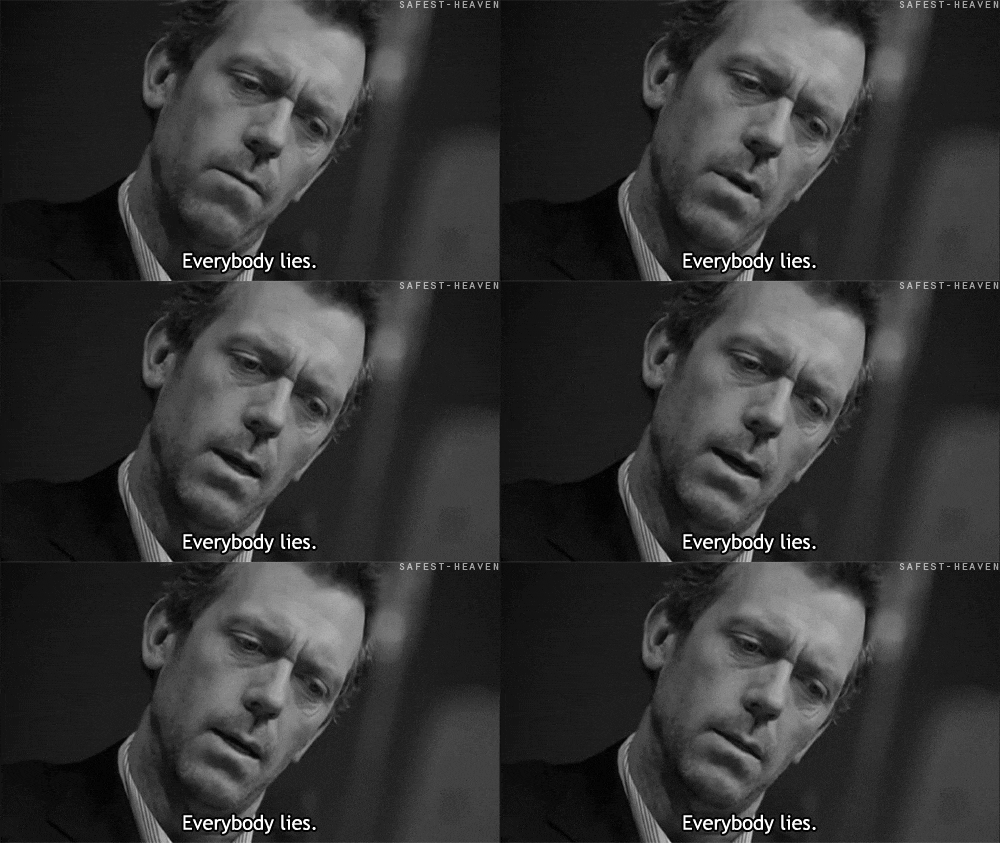
OKX, Tether and the US DOJ are 3 organizations we know jive very well like Mexican chili oil on an Irishman’s potato salad. OKX and Tether were allergic to having anything to do with US government just a couple weeks before their joint announcement, and Tether was notoriously antagonistic to freezing any USDT.
The record will show (from Nivie’s filings) that Tether and OKX prioritizes protection of VIP customers, including scammers and money launderers:
For one, the Turkish court ordered an immediate seizure of wallets to Tether and Binance in August 11, 2023, but Tether complied with it only in October 11, 2023. (Turkish authorities were not impressed with the delay.)
OKX received investigative requests for certain wallets they administer in early August 2023. They fully cooperated with Turkish investigators, but Turkish prosecution noted that the Seychelles-incorporated OKX belatedly filed a reactive mandatory compliance report to its regulator in the Seychelles, after the Turkish order. There was never a proactive identification of fake identities on OKX platforms.
Finally, the following text is worth showing (Exhibit N, partial):
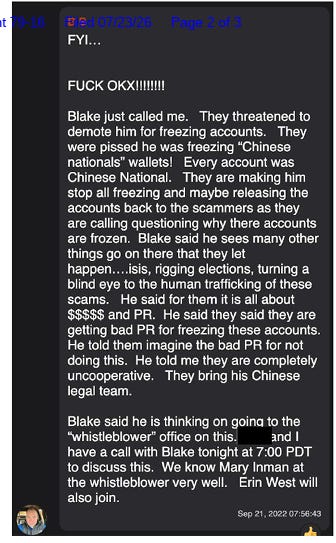
Context is in order:
In 2022, during the initial surge of “pig butchering scams”, a now-defunct scam victims organization called GASO had formed to support victims and provide structured intelligence to law enforcement, to help recover for victims assets lost to the scams. (I was a founding member.) GASO was working hand-in-glove with the FBI and Secret Service, to take in shell-shocked scam victims and provide US LE with clean, organized tracing data and scam compound information (perhaps more on this in future court filings). The above writer was Brian Bruce, then a GASO officer liaising with US law enforcement and an OKX contact, Blake Cohen.
Blake Cohen was then a young, idealistic American working as a new investigator for OKX in the US. He had initially offered GASO help in freezing and blacklisting OKX accounts reported or traced from scam victims.
The rant above shows that the OKX leadership was not happy with what Blake was doing when they got VIP complaints. They prohibited his further contact with GASO and by extension, with US LE:
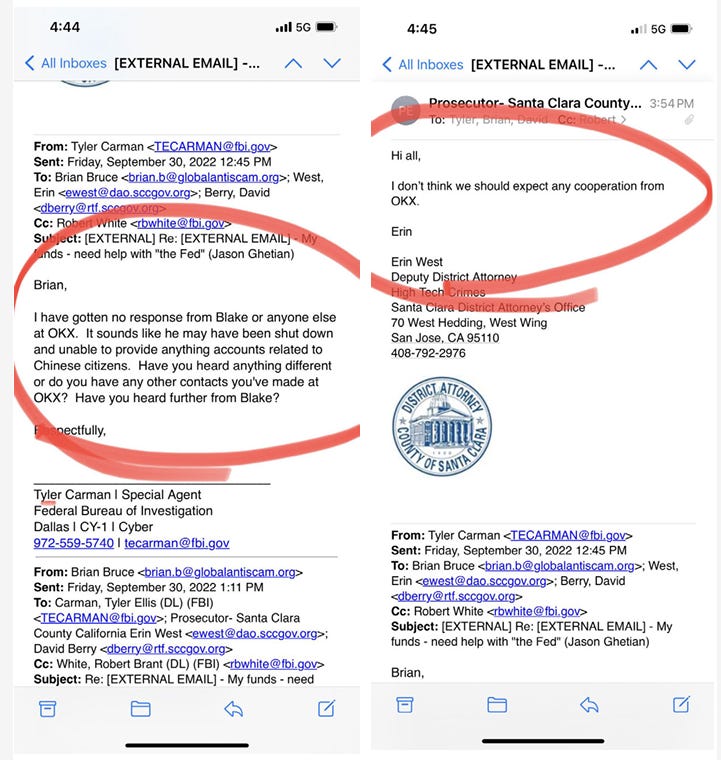
This is the attitude and culture inside the OKX mothership, of which Blake was still an outsider then. He went radio silent after this, but later (improperly) claimed credit for the supposedly OKX-driven seizure.
The Devil is in the Details
What did OKX get in return for volunteering scam account information to the US without warrants? Nivie put forth a very tantalizing chain of succeeding events:
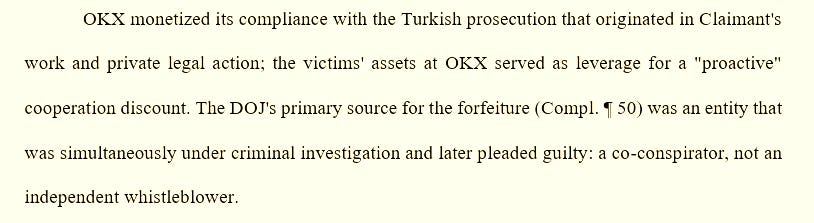
To spell out Nivie’s allegation, “lost” scam victim funds were used to pay the DOJ’s “criminal forfeitures” of these crypto exchange(s).
In February 24, 2025, the DOJ announced that OKX agreed to pay $504M in penalties for money laundering offenses. This sum are also to be applied as discounts in any possible future fines from CFTC. $84M of the total was the criminal fine, calculated from the base fine of $187M, multiplied by the minimum multiplier (0.6), minus a 25% discount for cooperation since early 2024.
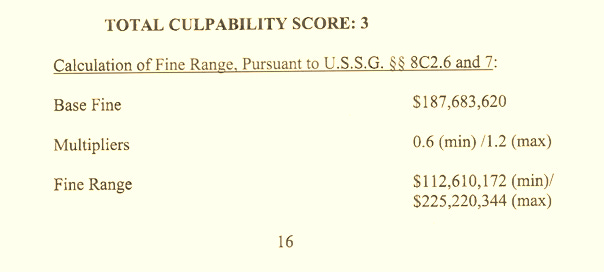
The rest of the fine —$420M— was criminal forfeiture to the US government. There was no formula basis stated for how $420M was arrived at in OKX’s plea agreement, and seems quite random. How do we know that these are still OKX’s corporate moneys and not from accounts already frozen and informed to be criminal e.g., from scams?
And what inspired Tether to send over $225M? Coincidentally with Tether’s letter to US Congress, the Binance plea agreement to pay an unprecedented $4.3B was also announced on November 20, 2023. The days leading up to this was already abuzz with anticipation of Binance’ impending deal with the DOJ. While $1.8B portion of the fine was explained as the amount in trading fees illegally collected by Binance from US customers over the years, $2.5B was simply criminal forfeiture. (Possibly more on this in the future.)
Where Binance ultimately sourced those funds to pay the billions will only be known to it, but Binance is an even bigger destination of scammed cryptocurrencies than OKX ever was.

The LIFO Forfeiture Machine
Regarding how the government uses victim information to construct ownership, Nivie raises a very troubling injustice (Document 79, page 18), especially as what eventually happened with the GASO victim data reporting pipeline: the government uses the Last-In-First-Out (LIFO) method of accounting when tracing cryptocurrency (and only for cryptocurrency), which mathematically destroys victim claims while preserving the maximum amount for forfeiture to the government.
LIFO was originally an inventory management principle where the last item stored is the first to be retrieved. The most recently produced items are the ones sold first, lowering inventory costs if earlier items cost lower (e.g. for tax purposes). When applied to crypto tracing, funds entering a crypto wallet last is counted as the first amounts leaving it.
While quick and direct, when used over series of mixing, commingling, splitting and other layering methods to launder money, LIFO will produce results where funds of the original reporting victims will be considered to have been lost and scattered, while the government will have new “tainted” moneys of vague criminal provenance to forfeit, in the final wallets frozen. The DOJ then uses the LIFO tracing results to disqualify scam victim claimants. LIFO is a “victim-exclusion mechanism”.
LIFO is just one among many accounting methods (FIFO, Pro Rata, etc.), but LIFO is widely recognizes as the one that produces the most inequitable results in trust law, insolvency, banking regulation, etc. In fact LIFO is prohibited in banking and in international accounting standards. The FBI manual itself doesn’t instruct using LIFO for tracing bank wire frauds —LIFO is only for crypto. There is no legal or judicial basis for choosing LIFO over other methods.
LIFO deserves its own long post. Here, Digital Defenders Group (DDG) excellently summarizes the problematic history, inherent inequity and dearth of legal basis for LIFO.
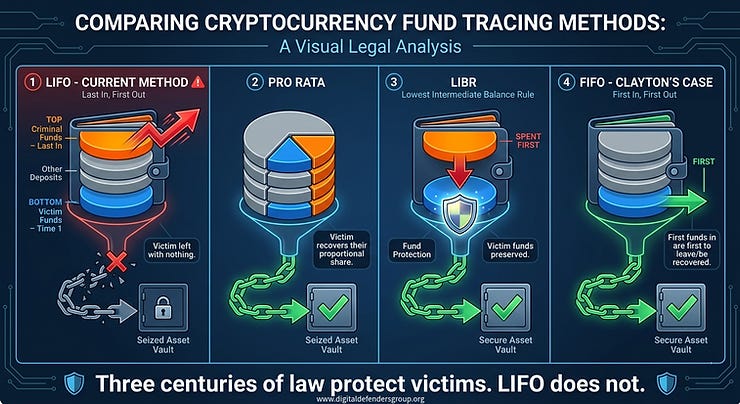
The practice of LIFO is made all the more concerning when it is further embedded into the crypto forfeiture architecture by US government contractors. Crypto analytics companies Chainalysis and TRM Labs promulgate LIFO, train US LE agents in it, and hire the top ex-LE agents versed in their methods. The DOJ Asset Forfeiture Fund —where forfeited criminal assets go— is not well known, but it is used to pay government contractors that provide operational and technical support. To quote DDG:
“The result: a closed loop in which the companies that profit from government contracts define the methodology that secures those contracts”
The Legal Side of the Scams Recovery Industry (A Preview)
The revolving door and conflicts of interest are seen also with US ex-DOJ Attorneys working on these fraud forfeiture cases. Nivie called out the most egregious example, the triple-conflicted ex-DOJ Attorney Dan Boyle, who is representing 118 victim claimants to the seized $225M in this case.
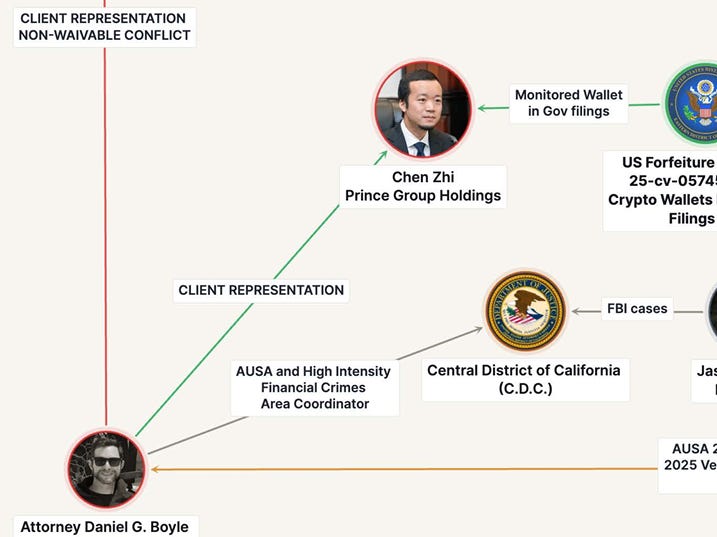
However, Boyle also represents Chen Zhi of the fraud factory/human trafficking-associated Prince Group conglomerate, fighting to keep the seized BTC for Chen Zhi in the concurrent $15B BTC forfeiture case (Case#3 in my last post).
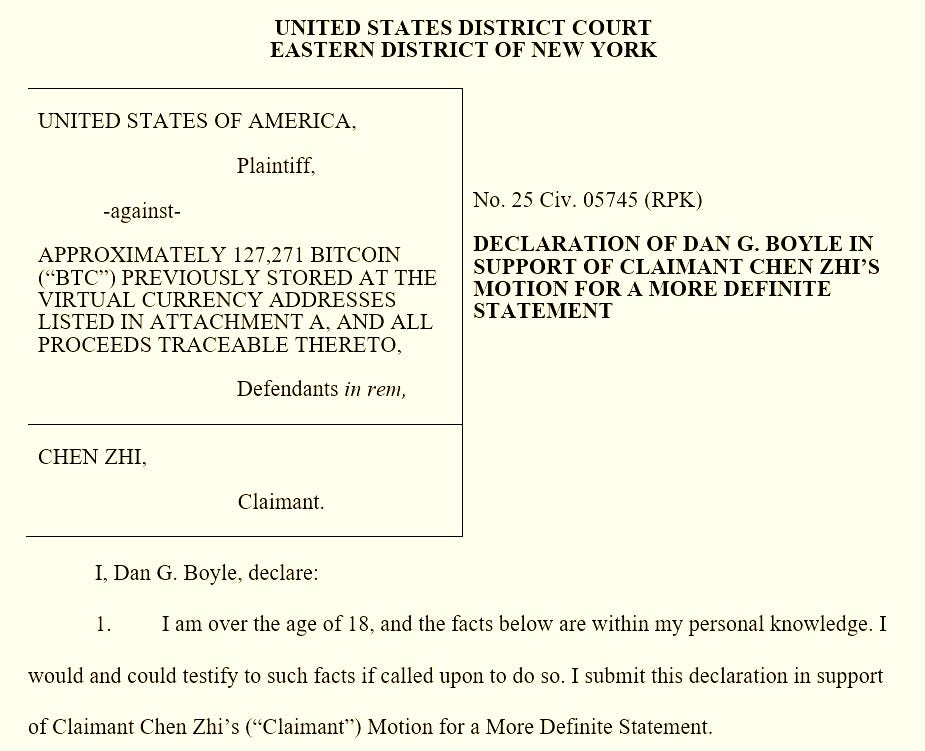
Southeast Asian crypto fraud factories are connected in nested, transnational money laundering networks, and the fact is, “pig butchering” scam victims can be parties in any of the cases against the Prince Group entities, like Infiniweb.
See also: The Chen Zhi Paradox in the DDG website
Nivie’s investigation made explicit that Infiniweb and Prince Group are simply the same criminal entity. The directors and owners of Infiniweb park their other companies in Prince Group “hotels” owned by Chen Zhi, in Cambodia (Exhibit M). In a criminal syndicate, money leaks upwards.
Atty. Boyle is playing both sides of essentially the same case: for scam victims in one court, and its accused perpetrator in another. (Nivie has also pointed out that all pig butchering scam forfeitures are related and ripe for consolidation.) Atty. Boyle should know, as he was the US Attorney (AUSA) in the seizure warrants in 2022 stemming from related scam wallets reported from GASO (Case#4 in my last post). Indeed, he is in the best position to have insider knowledge, to be able to shred DOJ forfeiture cases for those wallets; he knows first-hand how the bland DOJ forfeiture sausage was made.
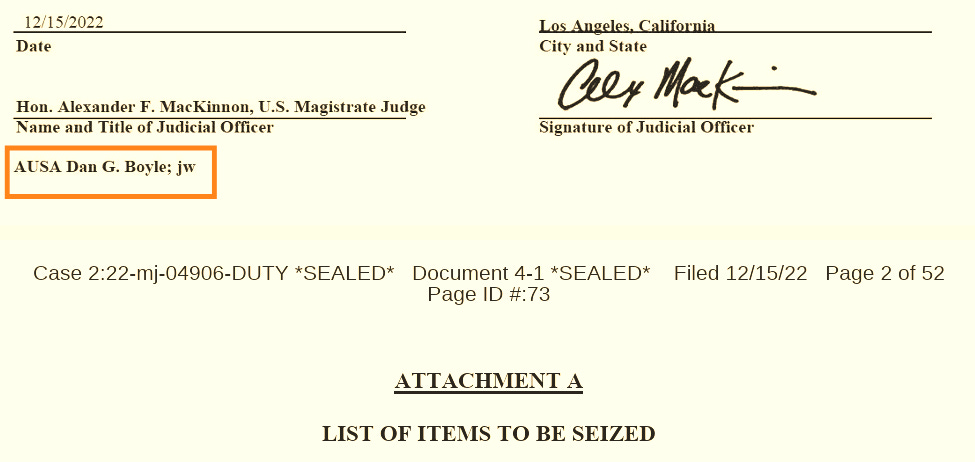
While being able to argue both sides could make good lawyers, the conflict above is not akin to being prosecutor in one murder case and being defense counsel in another. Murders with different characters can understandably be totally unrelated, but this is not the case for the thousands of scams connected to a web of transnational companies operating fraud factories in Asia. Additionally, it is not usual for US law firms to specialize on both sides, and even the appearance of conflicting interests is not permitted in legal professional ethics.
In yet ANOTHER conflict of interest, another law firm for 118 victim claimants (Greenberg Traurig LLP) was the defense counsel for Daren Li, a fugitive who was convicted in absentia 20 years for money laundering for pig butchering scams. The money he is claiming for his current clients could very well have been laundered by Daren Li.
Daren Li is a dual Chinese and St. Kitts & Nevis national and a resident of both Cambodia and UAE. He was arrested in the US in April 2024. But certainly thanks to his defense counsel, the jet-setting flight risk Daren Li was merely slapped with an ankle monitor after pleading guilty to money laundering charges, and subsequently escaped jailtime in the US while awaiting sentencing.
No Deal
Relying merely on blockchain tracing does not substitute for real world investigations. Victim claimants with only tracing data could not overcome the DOJ’s position, which itself is heavily dependent on tracing on its LIFO terms.
The lack of evidence, as well as conflicts of interest, could explain why enterprising lawyers for victim claimant groups could easily acquiesce to a settlement where criminals get the bulk of the $225M while also giving up of their clients’ rights to the assets. It was to be in exchange for backdoor priority for their clients on the remissions list for the remaining amounts, after discretionary costs. Signing off the assets to Infiniweb and accepting the flawed remissions framework will compound injustice to their clients. Remissions always result in pennies-on-the-dollar, and there is no legal recourse for petitioners as their rights have been extinguished. (But the lawyers still get paid, many upfront.) The quick and dirty deal is often not the most equitable nor in their clients’ best interest.
Nivie opposed the deal and asked for a Preliminary Injunction and for a trial. No doubt, Infiniweb is a criminal front. Investigations revealed in Nivie’s filings made headway on the real nature of Infiniweb (more than the DOJ ever did).
POGO licenses are thin legal covers for fraud factories, but POGOs like Infiniweb still has to be registered with Philippine Amusement and Gaming Corporation (PAGCOR), according Philippine regulations at the time. However, Infiniweb has never incorporated with the Philippines’ SEC, which was also a requirement for POGOs (Exhibit K - note the SEC certification would say if a company has ever registered and is now deregistered; the other similar-named companies are unrelated to gaming). Interestingly also, Infiniweb’s PAGCOR-listed address does not exist.
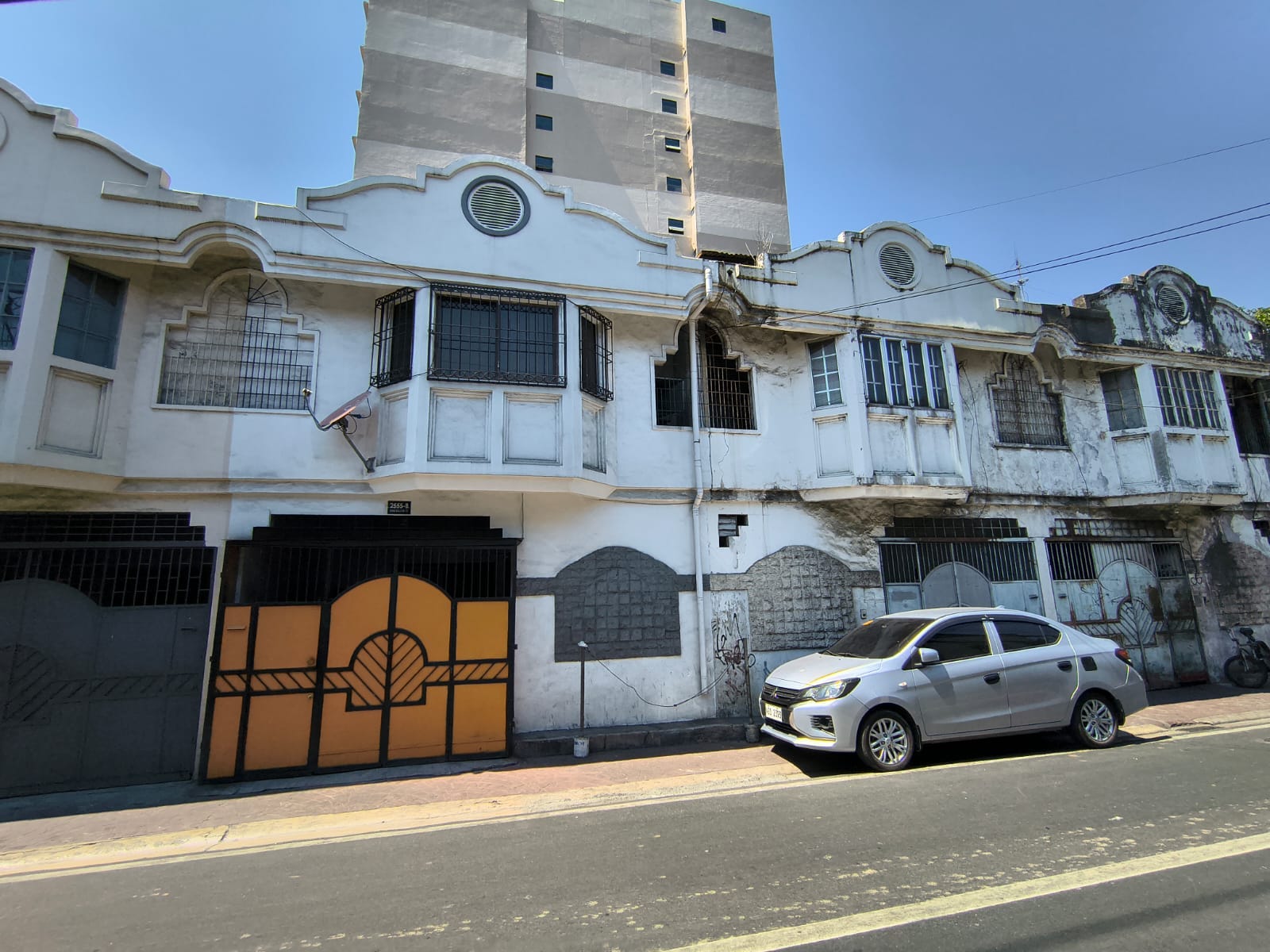
As such, Infiniweb never had a legal operation in its supposed home, let alone lawful income to justify claiming all $225M. Exhibit M further shows Infiniweb in the context of a Prince Group ecosystem. This still a subset of a bigger network.
Knowingly giving any part of the stolen $225M back to Infiniweb to avoid legal exposure is bordering unethical, and the DOJ was about to give most of it back to Infiniweb quietly. There are bigger implications that just this revictimization.
IF the settlement was allowed by the court, Infiniweb now gets to legally keep that bullion, because it will become a court-sanctioned settlement. Infiniweb can hence show to banks, regulators, and financial institutions around the world that its money is clean. Look, the US court approved it. That is judicial money laundering. This also creates a precedent for other forfeiture cases like the ~$15B Prince Group case, where the US also struggling to prove the criminality of the 127k BTC it wants to forfeit.
To end on a final note, and to be clear, Nivie’s filing is less a contest of US forfeiture laws but more a fight for due process for scam victims in the US: the claimant Nivie (a US citizen), has been deprived of property and due process by US government agents, including by concerning and frankly illegal extraterritorial actions. Her actions in the court is, in principle, about restoring standing to victim claims denied by the DOJ, while fending off Infiniweb claims. This is the context of her final sub-motion to create a court-appointed independent custodian outside of the US DOJ black box. It also hints at an alternative legal framework for restitution in large scam cases.
We all should look forward to an open trial on all their claims.
sdfkjbcsa;oifjdsogSfkjbxlkj
Originally published at The Coin Dryer. Follow more of this work at The Coin Dryer.