General Unsecured Creditors, not Owners
Conventional Wisdom — The Vanuatu Connection — Tether’s Victory Lap — The Chen Zhi Paradox — Legacy Forfeitures — Now Comes NK — What is the Big Deal?
******************************************************
Here comes a new blog post of The Coin Dryer, after a couple years of hiatus, with a bit of change in focus. Still on pig butchering scams and cryptocurrencies, but from another angle. Still the same genre.
******************************************************************************
The Conventional Wisdom
Here’s the way most people imagine things go for when one gets scammed in the US.
You report to the police. They open a case and investigate. The police track your stolen assets to the perpetrator and get a warrant to arrest him. The scammer gets tried in court and, upon getting convicted, gets his ill-gotten proceeds forfeited. After all is said and done, the court awards you your defrauded asset back.
Let’s try again, with modern elements.
You get scammed talking to someone online for a lot of money —crypto or bank wires. Unfortunately, it’s the notorious pig butchering scam, where your “lover” is someone chained in the KK Park casino city in Myanmar, where his fake investment website was made in the Philippines, and where your crypto assets got sent into the blockchain abyss, ending up in a wallet held by someone with a recently-acquired Cyprus citizenship.
You go to the police and get a police report. You report to the FBI, making an entry at the Internet Crime Complaint Center, ic3.gov. You send an email also to the Secret Service at CryptoFraud@usss.dhs.gov. You might even report to the US Federal Trade Commission.
Ideally, any of the law enforcement agencies opens a case, does an investigation, and with luck, freezes the crypto assets in time. With a lot of luck, it’s the elite Regional Enforcement Allied Computer Team (REACT) that takes the investigative lead and gets a warrant immediately to seize your funds.
Theoretically, law enforcement arrests a perpetrator or whoever is caught holding the bag, and proceeds with criminal proceedings. The government then argues in open court that the scammer is a scammer, likely using your testimonies and reports as evidence. A criminal trial runs its course, the scammer gets convicted, and the court awards the scammer’s forfeited assets to their rightful owner, you.
Let’s try again, being realistic.
Being the typical pig butchering scam case, US law enforcement is not able to arrest the perpetrators. Almost all of them and their conspirators are overseas. But it is able to seize fiat money and crypto assets here and there. To date in Mar 2026, assets seized by the US government under the aegis of stopping the so-called pig butchering scams has amounted to —without exaggerating— billions of dollars.
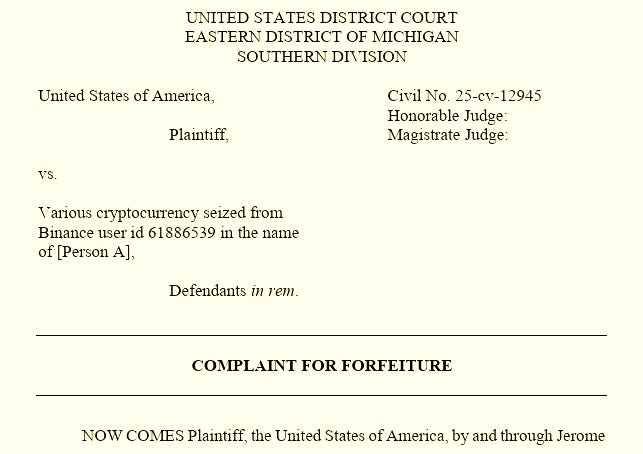
Without a defendant to try and legally deprive ill-gotten wealth from, what to do? The US government initiates a civil forfeiture proceeding in rem. Fancy legalese that somewhat means, to try the property itself, like it is a person. That is, government prosecutors will try to argue the criminal nature of the seized assets in a civil proceeding, in order for the court to award and title the seized assets in the US government’s name.
But it is not a criminal proceeding, and so the burden of proof is much lower. This is where problems arise. For one, think of all the black-box tracing solutions, arbitrary accounting methodology, and opaque attribution of address labeling sold to the government for its use by cryptocurrency analytics firms.
Also, does the government notify the owners that the government has custody of their asset and that it is getting forfeited? As part of a fair forfeiture proceeding, the government is required to give all potential owners ample opportunity to explain why they should not be deprived of their property. That is, for legitimate innocent owners to contest the proceedings that would forever title the asset in the US government’s name, be it cash, a car, gold bars, or cryptocurrency.
That US authorities have been unlawfully, unjustifiably, or unreasonably seizing and taking private property for itself, using civil forfeitures, at the expense of innocent owners not charged of any crime, has been a long-running, well-known problem tackled by libertarian nonprofit Institute for Justice. They document plenty of cases of abuse of civil forfeiture by US state and federal governments. It can only get worse with digital assets.

Unfortunately, the following is what typically happens to the multi-million/billion dollar seizures linked to pig butchering scams. There are big press releases by the US DOJ. The immediate owners of the frozen accounts, i.e. the last people caught holding the bag, comes out of the woodwork and hire prestigious US law firms to fight the forfeiture. Not having been convicted or even accused of any crime, they contest the seizure and forfeiture in US courts, as is very well their US 4th and 5th Amendment rights. In elegant filings, they argue quite forcefully of the hollowness of the US government’s entitlement to the seized property.
CASE #1: The Vanuatu Connection
The US government seized and alleges that about $1.6 million USDT and ETC were illicitly obtained and traceable to victims of scam platforms massusa.com and directedgebro.com (though not showing the work). The Binance account they were seized from belongs to a Vanuatuan citizen with a really Chinese-sounding name, Haiqiang Lu, after moving through two Malaysian-owned accounts.
Through Hongkong and Arizonan lawyers, Haiqiang Lu protested what in his view are insufficiently justified seizures, claiming to be an innocent buyer of those cryptocurrencies. In so many pages of court filings, he accuses the US government of failing to give due process, which invalidates the whole forfeiture. The US authorities never notified him the account owner, ignored his emails until far along the forfeiture process, and ghosted him.
In a country that prides itself in rule of law, everyone has the right to be heard, including the accused. It appears the court found this behavior by the US government concerning enough to not immediately grant the government’s prayer for forfeiture, and so the case is still ongoing today, for 3 years already.
CASE #2: Tether’s Victory Lap

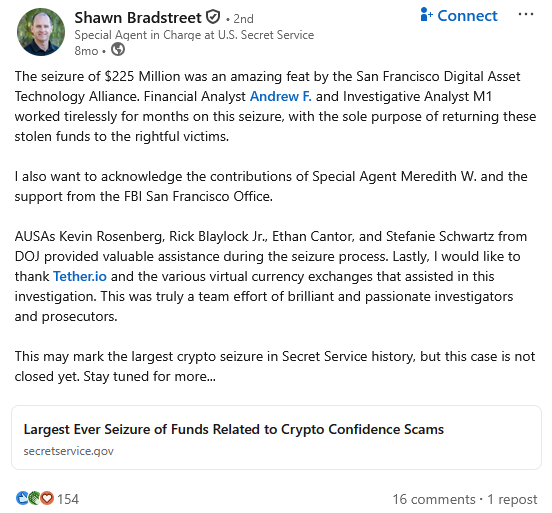
Remember the monumental $225M in USDT frozen in Nov 2023 thanks to the sudden “collaboration” of Tether and OKX with the US Secret Service (USSS)? The government filed for its forfeiture only much, much later, in June 2025. Those USDT apparently belonged to InfiniWeb, a self-professed online gaming and wagering company. From open source searches by the USSS agent affiant, Infiniweb operates in the Philippines, but is registered in the British Virgin Islands.
As it turns out, there was no warrant whatsoever for seizing that USDT bullion. Rather, Tether did a “proactive and voluntary” freeze of all of $225 million within 3 weeks of getting contacted by USSS and shortly after public pressure by US lawmakers for the DOJ to go after Tether. In fact, InfiniWeb says the warrant was made only retroactively, more than a 1.5 years after the US government has already seized the funds. And even then, the retroactive (!) warrant could only partially justify seizures of less than half of the wallets targeted.
Infiniweb maintains that even if those funds have been tainted (a point of dispute) long before it gained possession of those, it is an innocent owner. Its potential offense and criminality are also not the subjects being litigated. There is no criminal charge against Infiniweb; it argues that money laundering charges are being misapplied, with only flimsy and insufficient evidence at that.
Mere crypto tracing doesn’t prove criminality nor say anything about intent, which is true. The government’s original warrant application was trafficking in innuendos. Infiniweb complains as well that the USSS was being duplicitous and flaky also in its communications with it.
Read how Infiniweb’s ex-DOJ lawyers deliver a smackdown and school the DOJ on US money laundering statutes. Their message is a tour de force on the history and application of US money laundering statutes, if only who the messenger is isn’t so troubling.
Troublingly, the court has given enough credence to Infiniweb’s arguments. It seems even the DOJ has recognized Infiniweb’s standing as some owner of the $225M who can challenge the forfeiture. Other claimants as well have entered the forfeiture fight (more on this later). By March 2026, all these claimants and the DOJ went into active settlement negotiations. That the DOJ had to agree to negotiate says a lot about the inherent weakness of its case for civil forfeiture.
CASE #3 The Chen Zhi Paradox
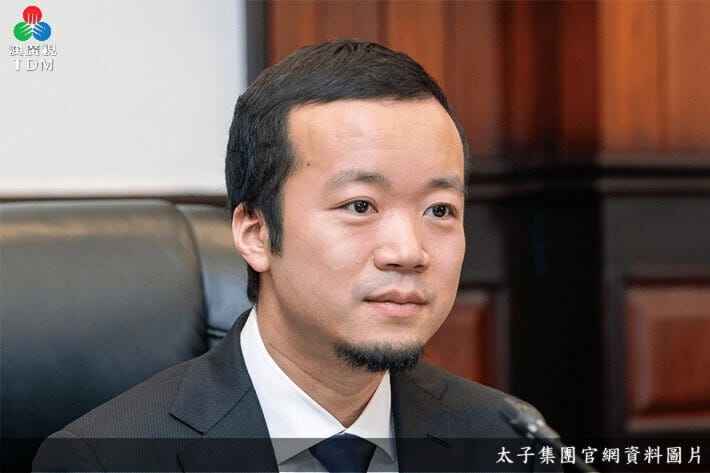
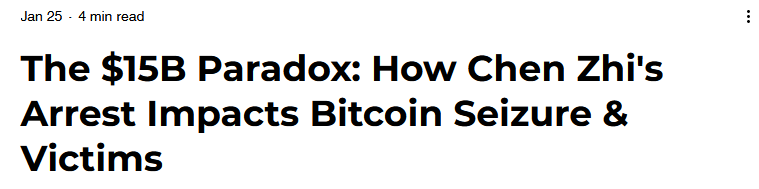
You should have heard of the ~$15B worth of Bitcoins seized by the US government, which linked it to pig butchering scams by way of their owner Chen Zhi of Prince Group. In October 2025 the US unsealed a criminal indictment against its chairman Chen Zhi. The US and UK in addition jointly sanctioned the Prince Group, along with the notorious Huoine Group, for being hubs of scams and money laundering. Indeed, Prince Group has long been a notorious Chinese-Cambodian conglomerate that reportedly owns and operates many massive fraud factories in Cambodia that continues to fleece people around the world.
Right of the bat, questions swirled around how the US government was able to acquire that ~127,000 BTC. You see, this motherlode of a seizure hasn’t been shown by anyone to really be laundered pig butchering scam money. It is apparently from the rewards of Bitcoin mining and other sources way back from 2019, and then stolen in 2020 under mysterious circumstances. This is all before pig butchering scams started becoming a thing outside China in late 2021 (I would know when pig butchering scam cases started in the US, because I started that unfortunate English term).
Beijing-affiliated cybercrime and cybersecurity research center CVERC published a detailed technical analysis (original) and basically accused the US of state-sponsored thievery. It demonstrated that the 127k BTC under forfeiture now is the very same one hacked from the now-defunct LuBian Bitcoin mining pool. The 127k BTC was dormant for 4 years until a case of “thieves falling out”, and the BTC loot got moved to US government wallets in 2024. Is this another warrantless seizure? It doesn’t bode well at all if the US couldn’t explain how it acquired the BTC.
See: Coindesk | China Accuses U.S. of Stealing 127K BTC in High-Profile Crypto Hack
Naturally, the Prince Group behemoth fights back in US courts. Aside from pointing out the chronological impossibility of these Bitcoins stolen in 2020 being the same ones from pig butchering scam cases post-2020, they needled the refusal of the US government to explain the progeny of the Bitcoins in question and even the sloppiness of the DOJ forfeiture complaint. Random photos, like one from an old Mongolian news site, were added in the DOJ’s main forfeiture complaint. (The photo had no connection at all to human trafficking in Cambodian fraud factories. See: Questions swirl around US plans for record $15B Prince Group crypto seizure - ICIJ)
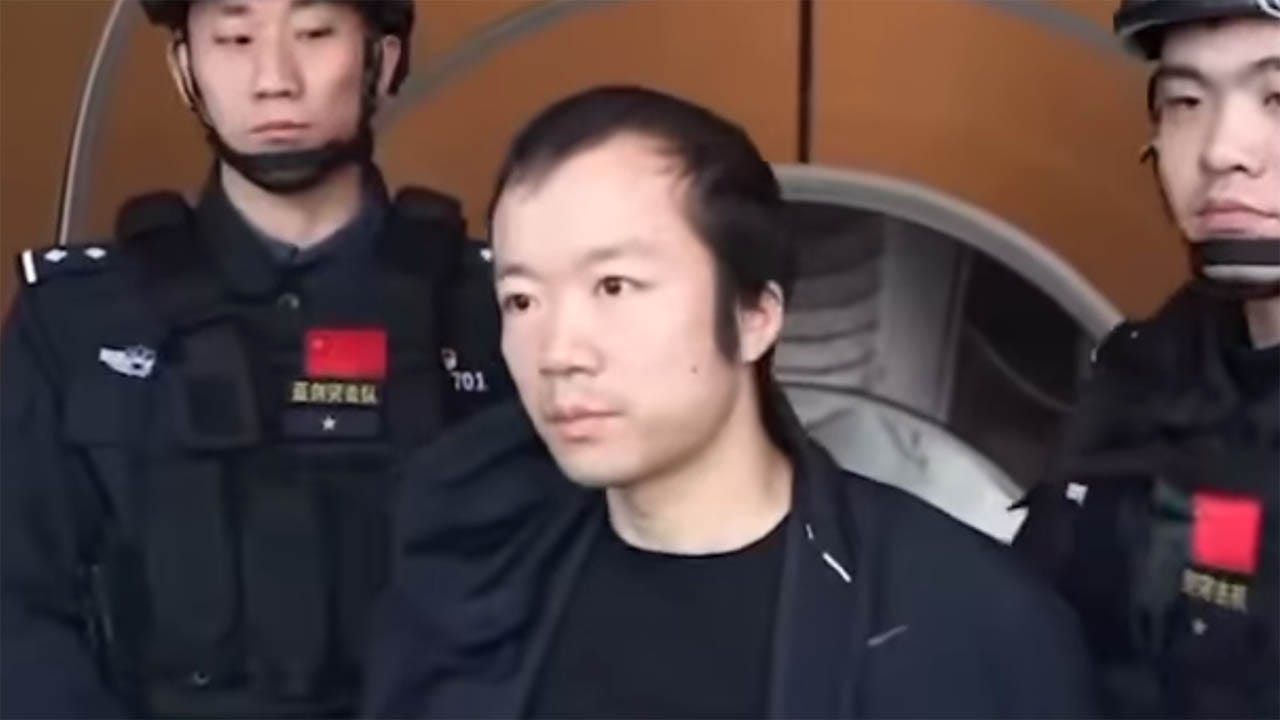
To compound things, Beijing had thrown a giant wrench in the US government’s plans to digest the $15B worth of BTC. It had Chen Zhi arrested and extradited back to China, in amazingly short order —2 months— with perhaps some Cambodian arms twisted. Chen Zhi has long been wanted in China for fraud cases against Chinese citizens. There is now no physical way for Chen Zhi to be tried and get criminally forfeited of his $15B BTC in a US criminal case. There are speculations by experts of the region’s geopolitics that this is a power play by China, to not let the US get that Bitcoin bullion from Chinese citizens so easily. It would also rather not have its (the CCP’s) “dirty laundry” air in open US courts.
You bet that like in Case #2 above, the DOJ civil forfeiture of the 127k BTC is destined to collapse, and the DOJ will be forced to negotiate away justice for scam victims, on the back of scam victims. Or worse, the court may decide that the ownership of the entire BTC loot has to revert to Prince Group. For a detailed analysis of the issues at play and implications for scam victims, turn to page The Chen Zhi Paradox in the Digital Defenders Group website.
CASE #4 Legacy Forfeitures
There are more examples of assets seized in the course of investigating pig butchering scams that are still in limbo. The US government is using civil forfeitures to get ownership title to all those frozen assets. Take for instance, about $163M currently being litigated in US courts in Michigan. It is a long overdue forfeiture proceeding of the ~$112M seized in early 2023 and linked to pig butchering scams (difference due to varying cryptocurrency prices).
Its original warrant mentions a victim’s group, Global Anti-Scam Organization. In those days warrants related to pig butchering scams treated GASO as an authority on pig butchering scams, but stopped short of acknowledging GASO as an investigation source. GASO was a group of pig butchering scam victims from 2020-2022, reaching to more than 3,000 individuals from around the world. At that time GASO worked hand in glove with US law enforcement agencies, with monthly meetings and weekly data uploads at various times. I would know, since I was an officer of this now-defunct organization, and saw fellow volunteers working day and night organizing scam victim data, rushing powerpoint slides, making sense of the Funnull and other scam networks, among other things, in hopes of speeding up the day victims get their money and life back.
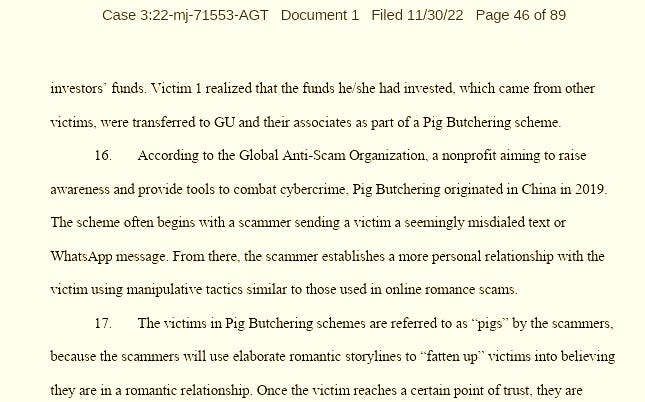
Fast forward to 2026, and none of the victims we know of whose scam platform was stated in the original 2023 warrant, the resultant FBI advert, and the Michigan forfeiture complaint has been called for testimonies that could support the criminal origin of the seized $163M in cryptocurrencies.
Increasingly, it has been left for intrepid victims to find lawyers (or intrepid lawyers finding victims) to intervene and assert their ownership claim in court, before their assets get divvied up to government bureaucracy and its contractors. In all the above cases, many victims of pig butchering scams, as well as other parties, have come to court to fight for their claim.
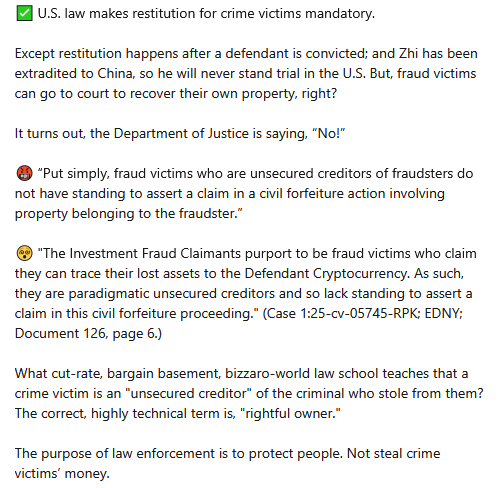
However, the official DOJ position, revealed in the $225M case, has been that victims have already forfeited their rights to their moneys when giving it away to scammers, and that victims have no more legal connection to the seized cryptocurrencies. Victims also do not have the specific evidence tying their case to the assets in question, never mind that most US government filings on those assets themselves lack specifics until recently, and unless forced to. (Never mind also the black-box tracing, imperfect attribution tags and arbitrary accounting methods.)
It also does not help allay fears of US victims of being revictimized by their own government that the vaunted US Strategic Bitcoin Reserve is supposed to be funded from asset forfeitures. As everybody knows, the US government has much, much bills to pay.
Questions swirl around US plans for record $15B Prince Group crypto seizure - ICIJ

Now Here Comes N.K.
The figurative conference table where the DOJ, Infiniweb, and other claimants hash out their differences for settlement must have flipped over when, on March 17, 2026, a scam victim, Nivie Kaul, filed a verified claim on the biggest wallet in the seized USDT pool. In 10 pages of sworn testimony, she flips over the conventional narrative of how the USSS found and compelled Tether to freeze an unprecedented $225M —all in under a month—and whether Tether’s freeze was truly voluntary.
Briefly, she details how her investigations into her own scam led to the unraveling of a criminal financing nexus in Turkey and the arrest of ~70 conspirators, including the owner of the wallets in question. This involved physical participation in criminal court proceedings and lengthy questioning by Turkish prosecutors, judge and opposing lawyers. An interim outcome was that of the Turkish courts ordering the “freezing” of the Tether wallets involved in criminal proceedings. This was after Tether arbitrarily refused to comply with a civil order earlier, per its supposed policy of complying only in criminal cases. (Rich, given that Tether complies with US civil forfeitures.)
The events in Turkey predated the joint announcement of Tether, OKX and US Secret Service on the $225M freezing by months. Around those months in early 2023 Nivie Kaul has also been actively communicating, reporting and exhorting US law enforcement agents all details and findings about her case, the same agents who then later claim credit in press releases, to great acclaim, for the good job they did in finding and getting Tether and OKX together to freeze all $225M.
See: New claim disputes facts of US landmark crypto seizure - Compliance Corylated
…………………………..
So why is her verified claim a big deal, aside from belying the government narrative? Because if accepted, it would supersede the claims of all the other parties. It can stop the forfeiture until her claim is resolved. It can stop Infiniweb, the next strongest claimant, setting up the space for equitable return of ALL assets to their rightful owners —the scam victims.
Setting aside whether foreign judgements have bearing in US courts, we can see that Nivie has the material information to succeed in a criminal trial that entitles her to those assets, a bar the US itself could not or did not bother to meet in its civil forfeitures of pig butchering scam victim assets. In making her claim, Nivie doesn’t merely have asset traces of her scam’s links to the cryptocurrencies in question. She has a bona fide criminal case that pinpoints an actor to a crime, which had justified a conviction and a forfeiture of those assets.
What is the Big Deal in All These?
The US government’s use of civil forfeitures in these instances are leading to awkward situations where it is forced to settle or even disgorge assets back to shady actors. Its weak, tortured cases are easily challenged by well-resourced “innocent” owners. Even if the US government succeeds in fighting off the challenge, victims lose in the opaque, discretionary remissions process —another can of worms.
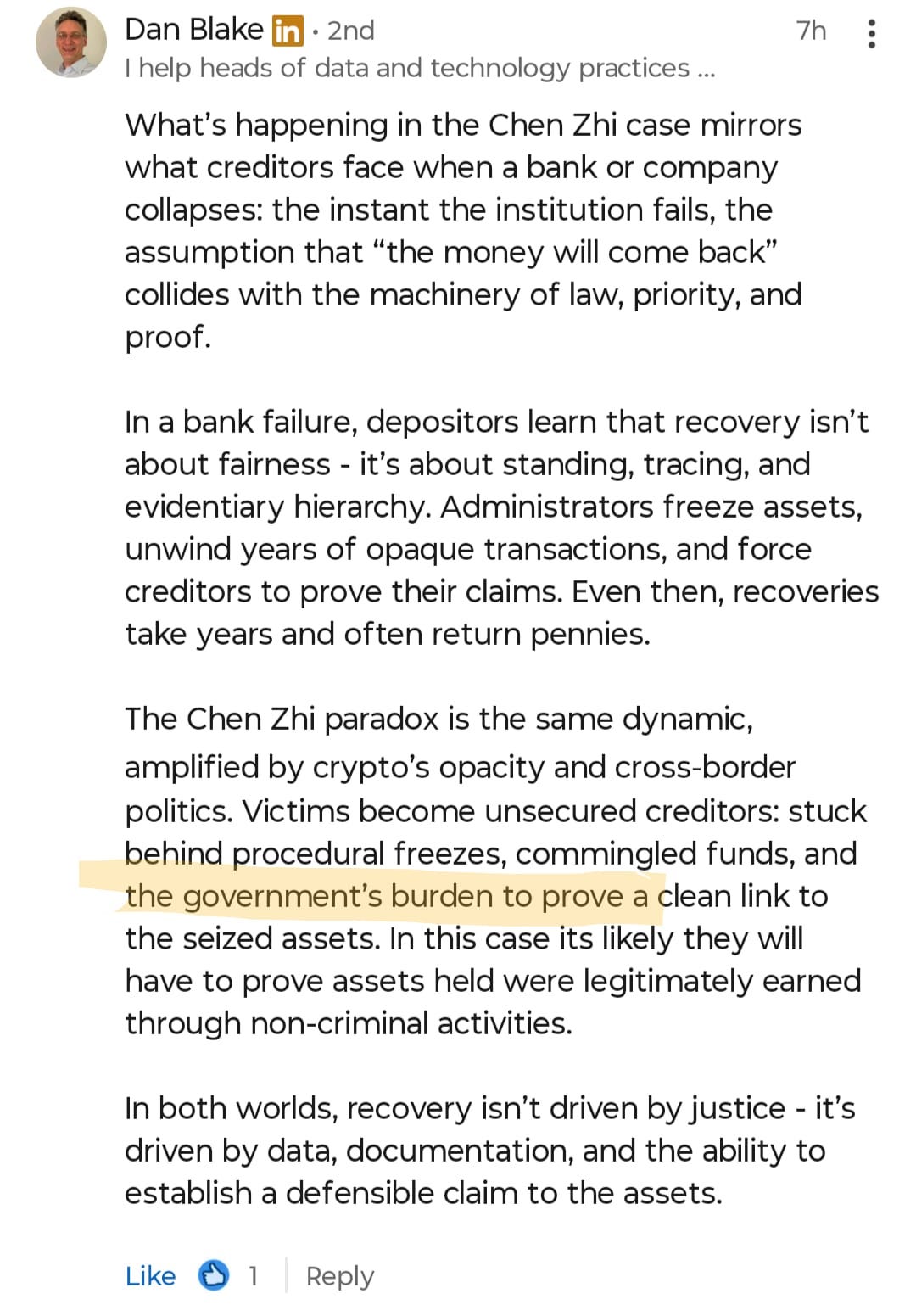
Couple this with the DOJ’s inscrutable policy of not acknowledging scam victims as having legitimate ownership stake in the seized assets. Instead, victims’ claims are all being rejected outright. The DOJ would rather not involve the very victims of those scams themselves in the forfeiture proceedings. In court filings, the DOJ considers victims of those scams as general unsecured creditors — last in line, paid only after all secured creditors, priority creditors, administrative expenses and lawyers, and with NO rights to any specific assets (Thomas Reuters).
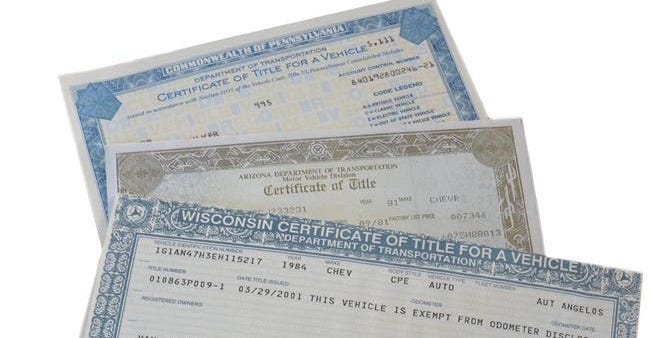
Imagine you got misled into lending your car to a fraudster who drove it away, never to return it. You report to police, and maybe even help the police narrow its whereabouts. The police finds your vehicle, but once they put their hands on it, it doesn’t belong to you anymore. Your car title means nothing. You have no more rights to it. You are now a ‘general unsecured creditor’, to be compensated for that car at their whim, if at all. Your compensation will simply be another agenda item competing for priority in their general funds.
The Institute for Justice has been advocating for the abolishing civil forfeiture as a tool for US government, to end its abuse, misuse, and overuse. Victims of cryptocurrency scams lose too much under the current modality. Civil forfeitures might be a potent tool to disrupt and deter drug and gang crimes, but it is patently inimical to the interests of victims of large-scale criminal frauds. Do victims have to first trade away their rights as owners of the crypto asset to then, maybe, probably, get something back as discretionary “restitutions”?
For the government, seizing assets has already disrupted and deprived fraudsters the fruits of their crime. Criminals can get frustrated and deterred. The public has been served by the very action of freezing assets. Does the government still have to insist on owning the frozen crypto for itself first, or can it step aside and sincerely give scam victims a real opportunity to prove their ownership of their stolen assets?
These real-life cases hopefully demonstrate to you that US victims of pig butchering scams have no real pathway to be made whole in the US. One should see from all these cases the Kafkaesque impossibility of getting back one’s defrauded assets from the US government. As seen in Nivie’s case, she did all her civic duty to report, cooperated fully, jumped through all the legal hoops, and yet is still being denied her claim to assets inexplicably held by the US government.
**********************
The significance of Nivie’s recent filing is that it cuts through the US government’s position on the standing of scam victims as unsecured creditors. The DOJ cannot easily dismiss her claim outright because she presents a criminal actor and a (foreign) conviction that can invalidate Infiniweb’s claim to the $225M. Making her still a ‘general unsecured creditor’ will be peak absurdity when she has a judicial lien on those assets, and when it was her actions in pursuit of her assets that were responsible for their freezing in the first place.
**********************
As it is now, scam victims will have to roll up their sleeves and step up in asserting their rights as the rightful owners. They need to save their assets from being negotiated away. Nivie Kaul is also the founder of Digital Defenders Group (DDG), a US non-profit whose pursuing scam victim assets anywhere in the world, wherever those may be, in a legal and equitable way. DDG is looking for more scam victims to join and participate for free in upcoming lawsuits.
Follow here or DDG LinkedIn for future updates. There are many, many more worms in the can to unpack.
a.kdslicwmfljrdg;kdsajfLSAKNGFLKDAJG;OIE
*********
STORY CONTINUES IN:
Originally published at The Coin Dryer. Follow more of this work at The Coin Dryer.